

Door Refinishing California Team
Historic Preservation Door Specialist · Door Refinishing California
⏱ 11 min read · Published September 2026 · Serving Mission Hills, San Diego, CA
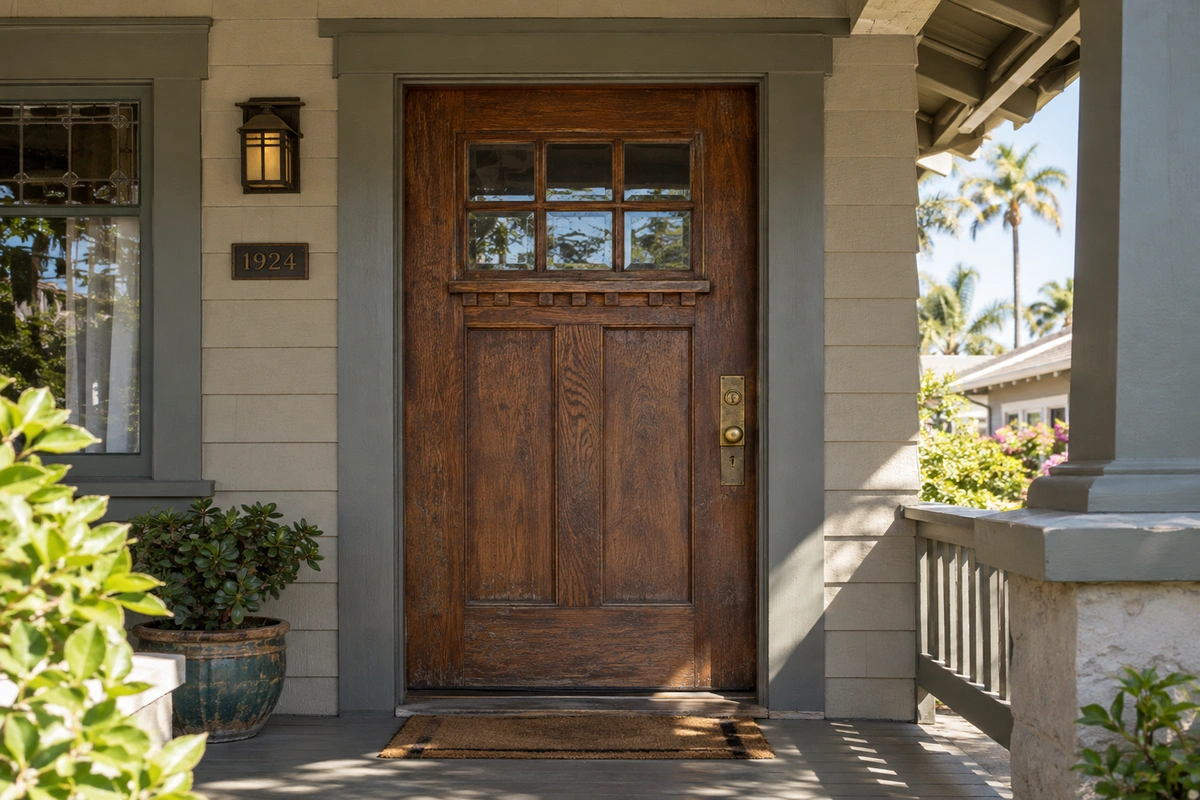
Mission Hills door refinishing is a different discipline than door refinishing almost anywhere else in San Diego County, and the reason has nothing to do with salt air or dry heat. It comes down to age and architecture. Laid out from a single 1908 subdivision plan and built out mostly between the 1910s and the 1930s, Mission Hills carries one of the densest concentrations of original Craftsman, Prairie School, and Spanish Colonial Revival entry doors left in the city. Most of these doors are ninety to well over a hundred years old, made from old-growth timber species that simply aren’t milled the same way anymore, and a meaningful share sit on properties that carry historic status with the City of San Diego. Refinishing one of these doors correctly means understanding the wood, the era, and the compliance path all at once — which is exactly where door refinishing San Diego homeowners searching from Mission Hills specifically run into trouble with generalist painters who treat every front door the same.
North Mission Hills vs. South Mission Hills: Two Different Exposure Profiles
Washington Street splits Mission Hills into two halves that behave differently once you’re talking about wood movement and sun exposure. North Mission Hills sits higher, closer to the rim overlooking Mission Valley, with more open western exposure on streets running toward the canyon edge. South Mission Hills sits lower and closer to Old Town and the harbor, with narrower, more tree-lined streets and denser infill that shades many entries for a larger part of the day. A door on a canyon-rim lot in North Mission Hills fights direct, unfiltered afternoon sun that dries out old-growth wood fibers faster than almost anywhere else in the urban core. A door tucked under a mature ficus or magnolia canopy in South Mission Hills, on the other hand, more often deals with trapped moisture, slower drying cycles, and the kind of soft, spongy rot that shows up at the bottom rail before anything looks wrong at eye level. Treating both halves of the neighborhood with one generic exterior finish is the single most common mistake we see from painters who haven’t worked this specific pocket of the city before.
Why the Marine Layer Clears Earlier Here Than on the Coast
Mission Hills sits at a moderate elevation between true coastal San Diego and the inland valleys, which gives it a genuinely in-between climate. The marine layer typically burns off by mid-morning through late spring and early summer, meaning doors here get less sustained fog exposure than La Jolla or Point Loma but still avoid the harshest inland heat spikes felt further east. That doesn’t make Mission Hills easier on a door — it just changes the failure mode from salt-driven finish breakdown to slow, cumulative UV desiccation of century-old timber that was never engineered for modern sun exposure in the first place.
A Neighborhood Built From a Single Plan — Why That Matters for Door Restoration
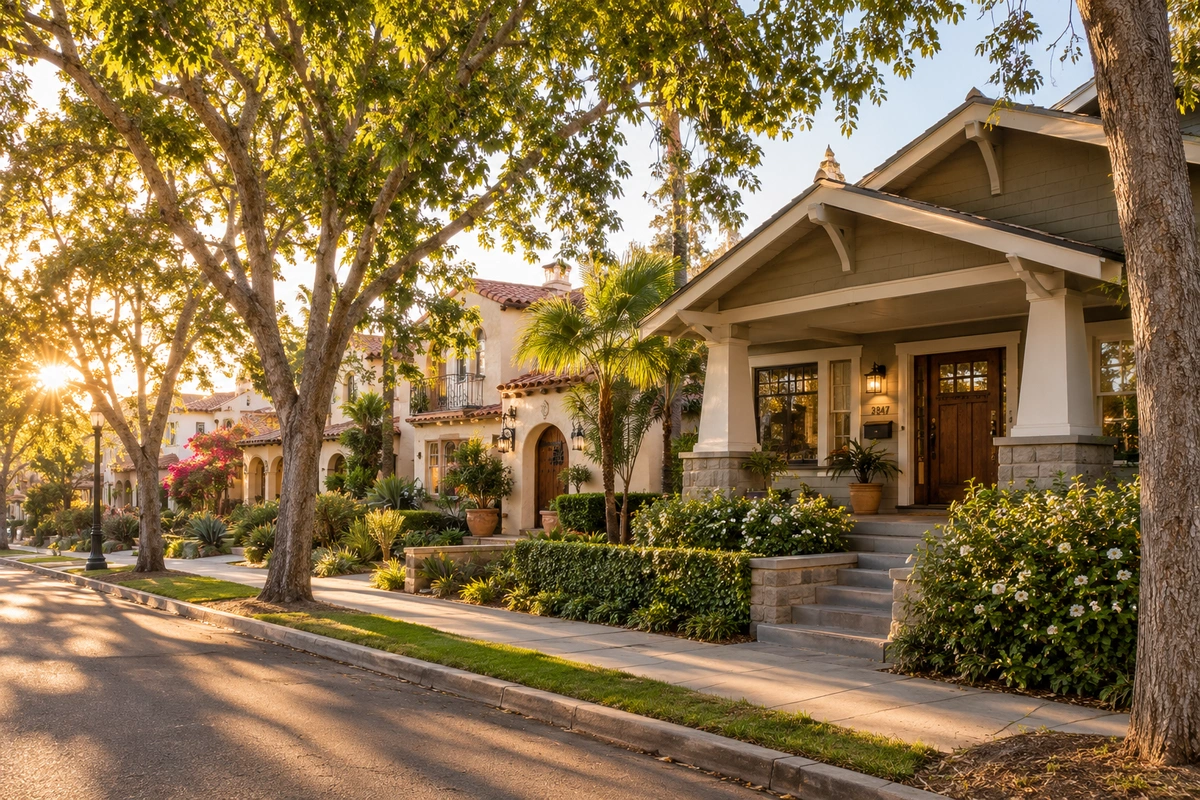
Much of Mission Hills traces back to a 1908 development plan from civic leader George Marston, and the result is a neighborhood with an unusual degree of architectural consistency for a city as sprawling as San Diego. Walk down Sunset Boulevard, Fort Stockton Drive, or the streets branching off the Goldfinch corridor and you’ll see the same handful of building styles repeating block after block: Craftsman bungalows with deep porches, Prairie School homes with strong horizontal lines, and Spanish Colonial Revival houses with stucco walls and clay tile roofs. That consistency is a gift for a specialist refinisher, because it means the door hardware, panel proportions, and wood species tend to follow predictable patterns within each style — but it’s a trap for a generalist, because a finish system built for a mid-century ranch door in Clairemont or a modern estate door in Rancho Santa Fe is simply the wrong chemistry for a hundred-year-old quarter-sawn oak Craftsman door.
Craftsman, Prairie School & Spanish Colonial Revival: Matching the Door to the Style
Each of Mission Hills’ dominant architectural styles calls for a different refinishing approach, and getting this wrong is how well-meaning homeowners end up with a technically “refinished” door that looks noticeably out of place next to the rest of the house.
| Architectural Style | Typical Original Door Material & Design | Refinishing Approach We Use |
|---|---|---|
| Craftsman (1910s–1920s) | Quarter-sawn oak or fir, exposed joinery, small divided-light glass panels | Gentle hand-stripping to protect joinery; oil-based penetrating stain in mission oak or dark walnut tones; satin sheen only |
| Prairie School (1910s–1920s) | Horizontal-emphasis paneling, often fir or redwood, minimal ornamentation | Grain-matched staining that preserves the flat, linear panel lines; low-sheen topcoat to keep the horizontal massing intact |
| Spanish Colonial Revival (1920s–1930s) | Plank-and-batten construction, hand-forged iron studding and strap hinges, arched or squared openings | Conservation-grade stripping around iron hardware; deep amber or chestnut gel stains; iron studding cleaned and re-blackened separately from the wood |
| Mid-century infill (1950s–1960s) | Flush slab doors, simpler hardware, occasional fiberglass replacements | Standard multi-coat exterior refinishing; less conservation constraint since these are not typically historic-designated |
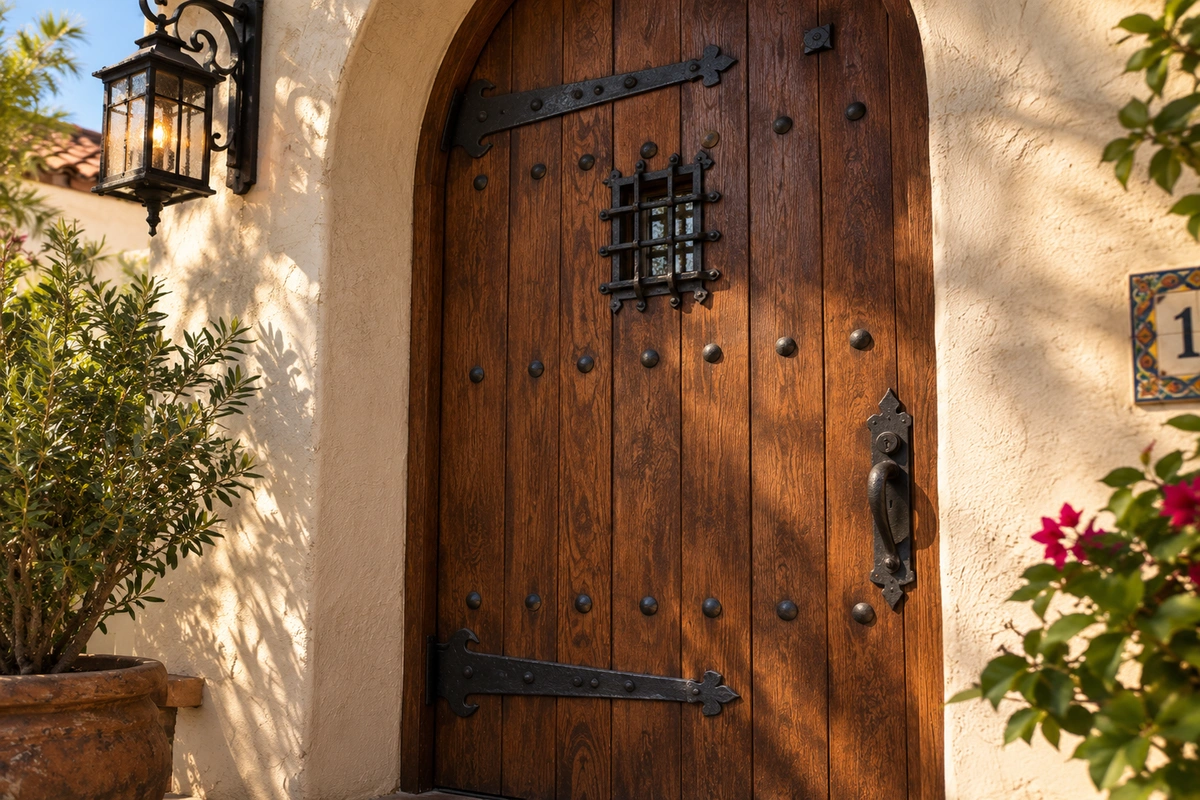
On an original Craftsman or Spanish Revival entry, we lean heavily on hand-sanding and conservation-minded chemical stripping rather than aggressive power-sanding, because the goal is preserving hand-cut joinery, sidelights, and transom details that a machine will round over in seconds. On the mid-century infill scattered through parts of the neighborhood, particularly closer to Washington Street and the West Lewis Street shopping district, we can apply a more conventional multi-coat exterior system without the same conservation overhead. This same conservation-first mindset shapes our approach to historic Craftsman restoration in Escondido, where a different but related set of preservation questions comes up.
East of Mission Hills, our Bankers Hill wood door restoration page covers Victorian and Craftsman entries near the canyon edges.
Mills Act Contracts and Historic Resources Board Review: What Homeowners Actually Need to Know
A meaningful number of Mission Hills properties carry a Mills Act contract, California’s property-tax incentive program that reduces assessed value in exchange for maintaining a home’s historic character. This is a different animal from an HOA architectural review. Rather than approving paint chips against a preset palette, San Diego’s Historic Resources Board is concerned with whether an exterior change preserves the documented historic fabric of the structure — and a poorly matched refinish on an individually designated landmark or a contributing property within a historic district can put that designation at risk. Some Mission Hills properties are individually listed; others are contributing structures within a historic district overlay, which carries its own separate review threshold. Homeowners are sometimes surprised to learn these are two different classifications with different documentation requirements, and confirming which one applies to a specific address is a step worth taking with the City before any exterior work begins.
Like-for-Like Re-Stain vs. Visible Change: Where the Compliance Line Falls
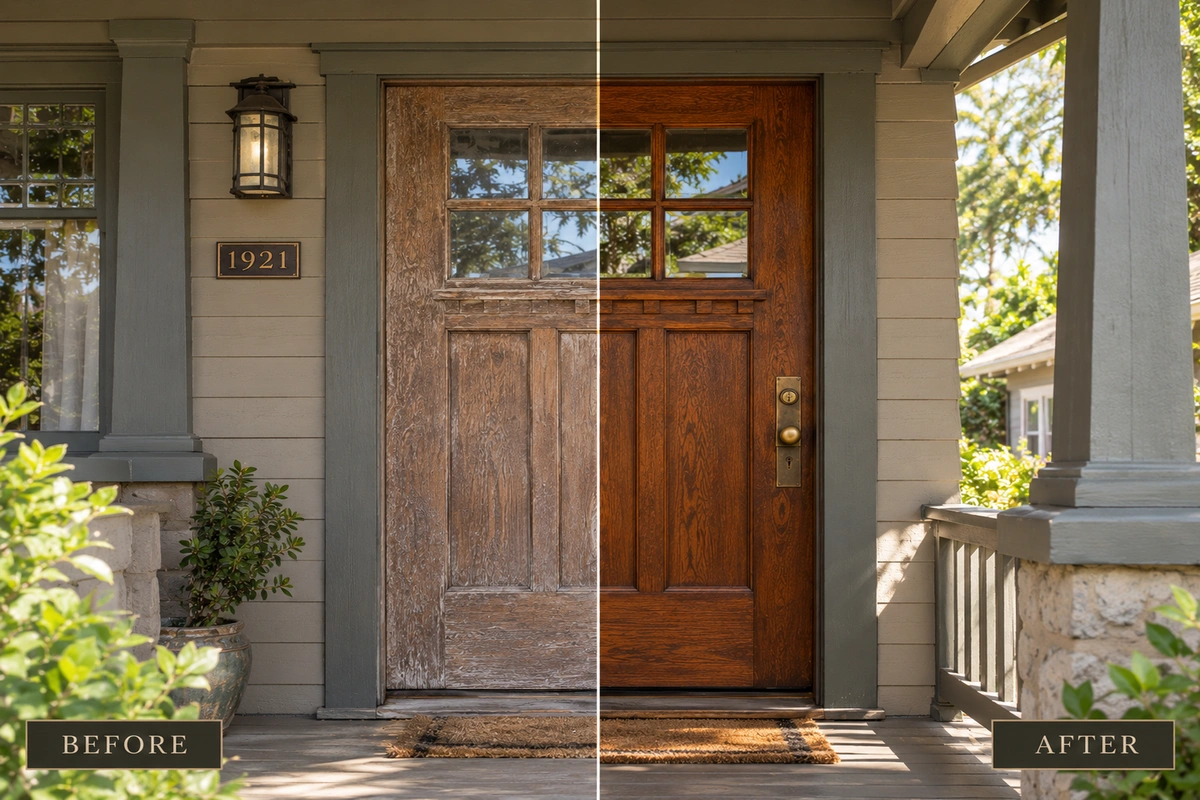
In practice, a like-for-like re-stain — restoring a door’s existing color, sheen, and material without altering its profile — typically does not trigger formal HRB review, even on a designated property. Where the line moves is any visible change: a different stain tone, a switch from a matte to a glossy topcoat, or replacing damaged original wood with a modern substitute material. We work from existing finish samples wherever possible and can provide documentation homeowners can keep on file for their own historic-district recordkeeping, but we are not a substitute for confirming requirements directly with the City on any project involving a genuine color or material change.
Hyperlocal Exposure Factors: Canyon Lots, Shopping-District Storefronts & View Corridors
Beyond the broad North-South split, Mission Hills has a handful of micro-conditions worth calling out by name. Properties backing onto the canyon edges near Presidio Park and the Mission Hills bluffs get more direct, reflected sun off the open canyon than interior lots do, accelerating UV checking on garage doors and exposed side entries. Commercial and mixed-use storefront doors along the West Lewis Street corridor face a different problem entirely: heavy foot traffic, frequent hand contact, and a faster cosmetic wear cycle that calls for a more abrasion-resistant topcoat than a quiet residential side street would ever need. And properties with harbor or Old Town view corridors — often the same homes commanding premium prices in the neighborhood — tend to have larger, more architecturally prominent entries that were built specifically to be seen, which raises the stakes on getting the historic color and sheen exactly right. It’s a different exposure profile than the direct marine spray we account for in Encinitas door refinishing work further up the coast, but it demands the same level of attention to detail.
Garage Doors and Iron Gates on Craftsman-Era Properties
Wood garage doors are less common in Mission Hills than in the newer suburban clusters further east, but where they exist — often on corner lots with detached period garages — they see significant thermal cycling from direct afternoon exposure with none of the canopy shade that protects the front entry. Wrought-iron gates, porch rail hardware, and the hand-forged strap hinges typical of Spanish Colonial Revival doors require their own maintenance track separate from the wood: cleaning, rust treatment, and re-blackening on a schedule that doesn’t necessarily match the door’s own refinishing cycle. We treat these as a single coordinated property plan rather than three disconnected jobs, using our wood door refinishing services alongside dedicated iron and gate restoration so that color, sheen, and hardware finish stay consistent across the whole entry.
Our Mission Hills Door Refinishing Process
Every Mission Hills project starts with an on-site assessment rather than a phone-only estimate, because the right process depends entirely on the door’s age, species, and historic status.
- Inspect the door’s wood species, joinery condition, hardware, and historic designation status
- Select conservation-grade hand-stripping for original pre-1940 doors, or standard stripping for later infill
- Hand-sand in progressive grits calibrated to the specific wood species and its condition
- Apply period-appropriate oil-based penetrating stain matched to the home’s architectural style
- Seal with a flexible, UV-stable topcoat in a historically appropriate satin or matte sheen
- Clean, treat, and re-blacken any original iron hardware or strap hinges as a separate coordinated step
For a full breakdown of the underlying stripping, sanding, staining, and sealing methodology we apply across every neighborhood we serve, see our Southern California door refinishing overview, and for general guidance on timing, see how often to refinish a door in San Diego.
Mission Hills Door Refinishing Cost Factors
Because every Mission Hills door carries a different combination of age, wood species, hardware, and historic status, we don’t publish flat rates. Instead, pricing is shaped by the specific factors below, assessed during a free on-site visit. For a county-wide breakdown of how coastal versus inland exposure shifts pricing more broadly, see what door refinishing actually costs in San Diego.
| Cost Factor | How It Shapes the Project |
|---|---|
| Historic Designation Status | Individually designated and district-contributing properties call for conservation-grade prep, archival color matching, and finish documentation, which adds time relative to a non-designated infill home |
| Wood Species & Condition | Original old-growth oak, fir, or redwood in fair-to-poor condition requires more careful hand-stripping and grain conditioning than a modern replacement door |
| Hardware Complexity | Hand-forged iron strap hinges, studding, and multi-point historic locksets require separate cleaning and re-blackening beyond the wood refinishing itself |
| Sun & Canyon Exposure | Canyon-rim lots near Presidio Park and open western-facing entries in North Mission Hills typically need a higher-build UV-stable topcoat than shaded South Mission Hills entries |
| Commercial / Storefront Use | West Lewis Street storefront and mixed-use entries need a more abrasion-resistant topcoat to withstand daily foot traffic and hand contact |
Why Mission Hills Homeowners Choose Door Refinishing California
Chism Bros. Painting, a long-standing native San Diego painting company, has published general blog content referencing individual Mission Hills refinishing jobs, and it’s a credible, experienced shop — but it’s a general painting company first, without a dedicated historic-compliance process or a neighborhood-specific resource built around the Mills Act and HRB questions Mission Hills homeowners actually ask. StainDoor, LLC, which advertises broad Southern California coverage, lists only San Diego, La Jolla, Carlsbad, Encinitas, Oceanside, and Chula Vista in its San Diego County service area — Mission Hills doesn’t appear on their site at all. That leaves a clear gap for a specialist that combines door-specific refinishing skill with real, working familiarity with the neighborhood’s historic-review process, its North-South exposure split, and its architecture-specific door materials. For a broader look at how Door Refinishing California stacks up against the wider San Diego competitive field, see our 2026 buyer’s guide to door refinishing in San Diego, or read more about our team’s background. Backed by a 5.0-star rating across 110+ verified Google reviews, our team is ready to schedule a free on-site estimate for your Mission Hills property.
Interior Woodwork: Built-Ins, Cabinetry & Original Millwork
The same 1908 building boom that produced Mission Hills’ dense stock of original front doors also left many Craftsman bungalows with built-in china cabinets, box-beam ceilings, and original kitchen millwork that homeowners are increasingly restoring alongside their entry doors rather than replacing during a remodel. This interior woodwork typically shares the same old-growth oak or fir species as the exterior doors, which means the same stain-matching skill that gets a front door right also applies indoors. We treat a Mission Hills project as a single cohesive finish plan whenever a homeowner wants it that way, using our door repair and maintenance services to keep original built-ins, cabinet faces, and entry doors color-matched throughout the home rather than ending up with a beautifully refinished front door next to a mismatched interior stain tone from a previous owner’s touch-up.
This is also where we most often catch a detail that a door-only refinisher would miss: original hardware. Push-plates, mail slots, and interior cabinet pulls from the 1910s and 1920s were frequently solid brass or bronze rather than plated, and a proper restoration cleans and re-lacquers this hardware rather than replacing it with a modern reproduction that reads as slightly off against a genuinely restored door.
Frequently Asked Questions
The questions below come up most often from Mission Hills homeowners specifically, and they’re distinct from the broader historic-compliance questions we field for the rest of the Central & Coastal San Diego corridor. For general county-wide questions, see our full door refinishing FAQ page.
Is my Mission Hills home more likely to be historic than a similar-age home elsewhere in San Diego?
Yes, relative to most of the city. Because the neighborhood was built out almost entirely from Marston’s 1908 plan, a larger share of Mission Hills homes fall within a historic district overlay or carry individual designation than in newer parts of San Diego. Confirming your specific property’s status with the City is worth doing before any visible exterior change.
Does a door on a canyon-rim lot in North Mission Hills need a different finish than one in South Mission Hills?
Generally, yes. Open canyon-rim lots near the Mission Valley side see more direct, unfiltered afternoon sun and typically need a higher-build UV-stable topcoat, while shaded South Mission Hills entries closer to Old Town more often deal with slower drying and moisture retention rather than pure sun damage.
Can you refinish a hundred-year-old Craftsman door without damaging the original joinery?
Yes. On pre-1940 originals we use conservation-minded hand-stripping and hand-sanding rather than aggressive power tools, specifically to protect the hand-cut joinery, divided-light glass panels, and sidelight details that machine sanding can round over or damage.
My property has a Spanish Colonial Revival door with hand-forged iron studding. Do you treat the wood and iron separately?
Yes. Iron studding, strap hinges, and hardware are cleaned, rust-treated, and re-blackened as their own step, separate from the wood stripping and staining process, since metal and old-growth timber respond to very different treatment cycles.
Do storefront doors along West Lewis Street need a different approach than a residential entry?
Yes. Commercial and mixed-use entries along the West Lewis Street corridor see significantly more foot traffic and hand contact than a quiet residential side street, so we specify a more abrasion-resistant topcoat to hold up to daily use.
Will refinishing my door affect my Mills Act contract?
A like-for-like re-stain that preserves your door’s existing color, material, and profile is generally not the kind of change that jeopardizes a Mills Act contract. Visible changes — a different stain tone, a different sheen category, or replacing original material — are the kind of alterations worth confirming with the City in advance.
How long does a historic door refinish take in Mission Hills compared to a standard door?
A conservation-grade refinish on an original pre-1940 door typically takes longer than a standard modern-door refinish, because hand-stripping and hand-sanding around delicate joinery and glass panels simply can’t be rushed the way machine sanding on a flush modern slab can be.
Can you match the stain on my front door to original built-ins or cabinetry inside the house?
Yes. Many Mission Hills Craftsman bungalows share the same original wood species between the front door and interior millwork like box-beam ceilings, built-in china cabinets, and kitchen cabinetry. We can color-match across all of it during the same project so the finish reads as consistent throughout the home rather than as a series of separately toned surfaces.
Get Your Free Mission Hills Door Refinishing Quote
Whether your home sits on a canyon-rim lot in North Mission Hills, along a shaded street in the historic South Mission Hills core, or fronts West Lewis Street, our team is ready to assess your door in person. Backed by 5.0 stars across 110+ verified Google reviews and a decade-plus of Southern California door refinishing experience, we bring conservation-grade care to every original Craftsman, Prairie School, and Spanish Colonial Revival entry we touch. For a broader look at how we approach the rest of the urban core, see our Central & Coastal San Diego door refinishing hub, or explore our work in neighboring La Jolla door refinishing and Point Loma door restoration projects. Browse our portfolio of restored entries for examples of completed work, then reach out today to schedule your complimentary on-site estimate.
Get Your Free Mission Hills Door Refinishing Quote
Want to send photos of your door? Text two or three photos (inside, outside and a wide shot of the entrance) to (619) 777-7171. A clear photo helps us give you an accurate estimate.