
Table of Contents

Door Refinishing California Team
Cost & Estimating Specialist · Door Refinishing California
⏱ 14 min read · Published August 2026 · Serving San Diego County, CA
Ask three San Diego door refinishing companies for a quote and you’ll likely get three different numbers, three different explanations, and no clear sense of why. That’s not because pricing is arbitrary — it’s because door refinishing cost San Diego homeowners actually pay is driven by a variable most estimates never mention out loud: which side of the marine layer your ZIP code sits on. A door in 92037 and a door in 92027 can be the same size, same wood species, same age, and still require a completely different coating system, prep process, and labor scope, simply because of where they sit.
This guide breaks that variable down directly. Instead of a single average number that doesn’t apply to your actual property, you’ll see exactly which cost drivers apply to coastal ZIP codes, which apply to inland ZIP codes, and where the two overlap. We’ll also walk block-by-block through the specific San Diego areas that shape pricing the most, with links to the full local breakdown for each.
Why “Cost” Isn’t One Number in San Diego
Most home service quotes scale with size and labor hours. Door refinishing does too, but San Diego County adds a third variable that flatter, more uniform markets don’t have to deal with: microclimate severity. A door’s exposure to salt fog, UV radiation, or dry inland heat directly changes how many prep steps are required, which stain and sealer chemistry is used, and how many protective coats the finish needs to actually hold up.
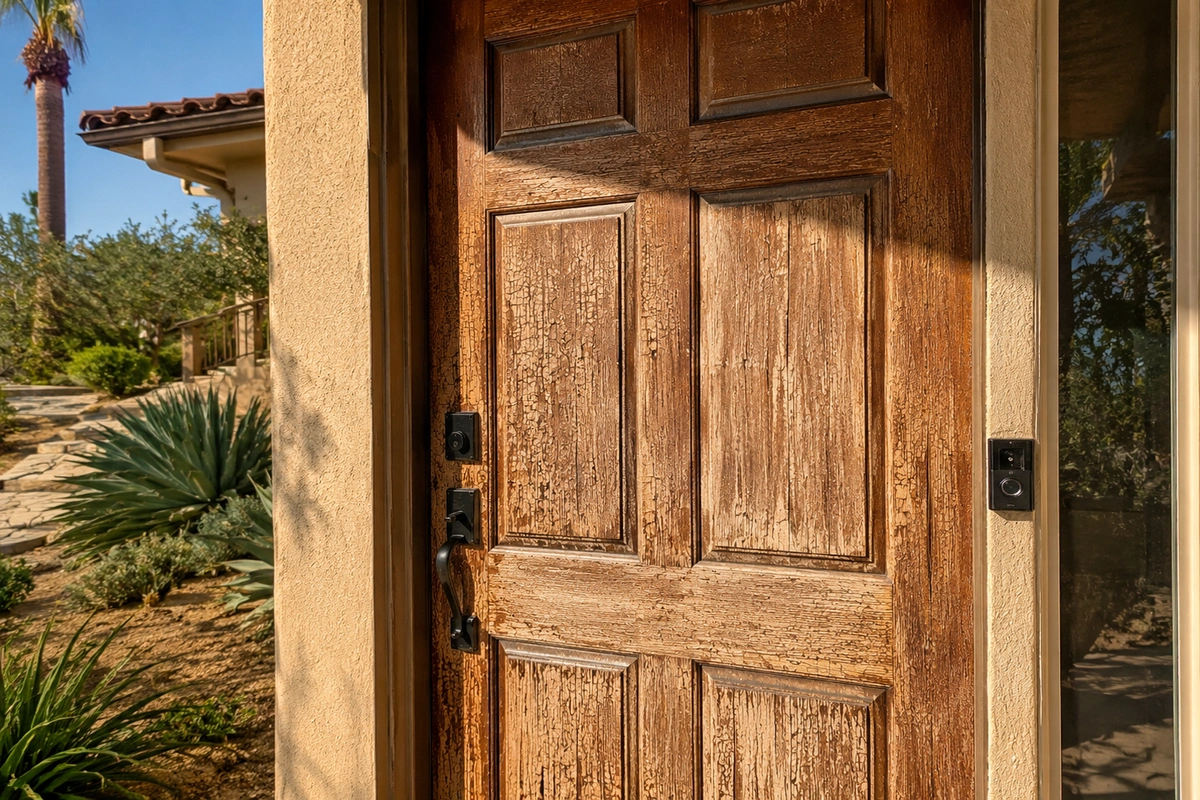
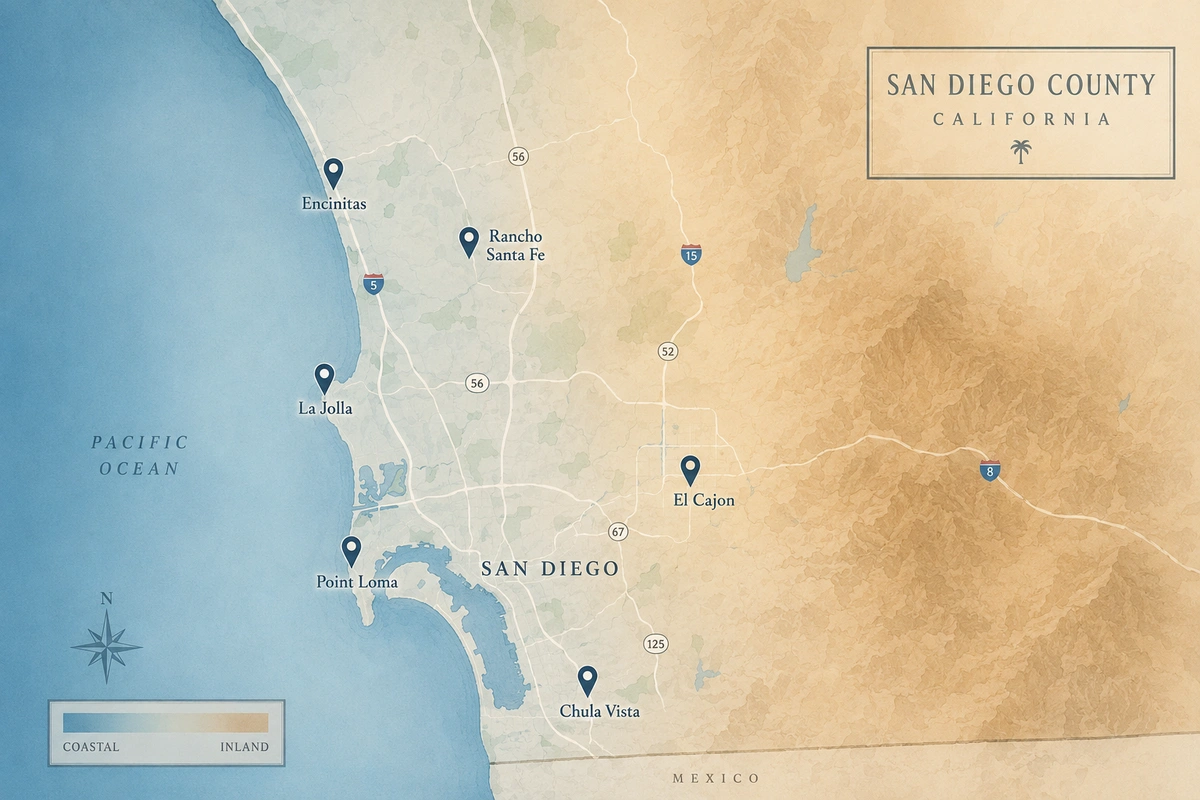
That’s why a generic “average cost” figure is close to useless here. Two homeowners with identical front doors — same size, same wood, same age — can face a meaningfully different scope of work depending on whether their door sits three blocks from the Pacific or twenty miles inland. San Diego County is also unusual in how quickly that exposure can change over a short distance. Unlike a market where climate shifts gradually over hundreds of miles, San Diego’s coastal-to-inland transition can happen within a fifteen-minute drive, which means two neighborhoods that feel similar on paper can require entirely different coating strategies.
The rest of this guide walks through exactly why, starting with the two broad climate zones that drive the split, then narrowing down to the specific ZIP codes and neighborhoods within each. Along the way, we’ll also cover the two factors that matter regardless of location — material and current condition — since even a coastal door in excellent shape can cost less to refinish than an inland door that’s been neglected for years.
Door Refinishing Rancho Santa Fe
The Coastal Belt: What Actually Drives Cost Near the Water
Coastal San Diego ZIP codes — 92037 (La Jolla), 92106 (Point Loma), 92109 (Pacific Beach), 92118 (Coronado), 92014 (Del Mar), 92075 (Solana Beach), and 92024 (Encinitas) — share a specific failure pattern that shapes almost every line item in a refinishing quote. Morning marine layer moisture saturates exposed wood grain, then afternoon sun bakes that same moisture out rapidly. That “damp-then-bake” cycle causes standard stains and clear coats to micro-crack and peel far faster than they would inland, which means coastal properties usually need a marine-grade, UV-inhibited coating system rather than a standard exterior product.
Salt air adds a second cost driver specific to this belt. Airborne salinity abrades topcoats and, on iron or metal doors and hardware, accelerates rust and corrosion. That’s why coastal quotes frequently include rust-inhibiting primer work on hinges, locksets, and iron gates that an inland quote wouldn’t need at all. Properties in the immediate coastal core — La Jolla, Point Loma, and the Coronado peninsula in particular — tend to sit at the higher end of the coastal cost range because they combine both stressors: heavy humidity swing and direct salt exposure.
The Inland Belt: What Actually Drives Cost Away From the Coast
Move twenty minutes inland — into ZIP codes like 92067 (Rancho Santa Fe), 92064 (Poway), 92131 (Scripps Ranch), 92025–92029 (Escondido), 92019–92021 (El Cajon), and 92071 (Santee) — and the failure pattern flips entirely. Humidity drops, UV intensity climbs, and doors fail through cracking, checking, and rapid color fade rather than peeling or blistering.
That shift changes the cost drivers in a different direction. Inland refinishing typically requires deep-penetrating conditioning oils to replace moisture the wood has lost, plus a higher concentration of UV inhibitors in the topcoat to slow lignin breakdown — the process that causes fading and brittleness under sustained direct sun. Canyon-adjacent ZIP codes like El Cajon and Santee, which trap heat and see some of the highest sustained temperatures in the county, tend to need a thicker clear-coat build to prevent cracking, which adds labor time even though there’s no salt-related rust work involved.
Rancho Santa Fe and Poway carry an additional factor that isn’t purely climate-related: many properties in these communities have HOA-governed aesthetic standards and higher-end architectural doors — solid mahogany, custom iron, oversized double-door entries — which pushes projects toward the upper end of the inland range on material and complexity grounds rather than climate severity alone.
Scripps Ranch and the western edges of Escondido sit closer to the middle of the inland range. They still deal with the dry-heat cracking pattern common across the belt, but without the extreme sustained temperatures seen in the deeper canyon terrain of El Cajon and Santee, so the clear-coat build required is typically less aggressive than in those hotter pockets. This is a useful reminder that “inland” isn’t a single uniform pricing tier any more than “coastal” is — it’s a range shaped by exactly how much heat and how little humidity a specific property actually experiences day to day.
| Cost Driver | Coastal ZIP Codes (92037, 92106, 92118, 92014, 92075, 92024) | Inland ZIP Codes (92067, 92064, 92025–92029, 92019–92021, 92071) |
|---|---|---|
| Primary failure mode | Peeling, blistering, clouding from humidity swing | Cracking, checking, fading from UV and dryness |
| Coating system needed | Marine-grade, flexible spar urethane | UV-stable, high-build clear coat |
| Extra prep typically required | Salt residue removal, rust-inhibiting primer on hardware | Deep-penetrating conditioning oil before staining |
| Metal/iron risk factor | High — salt-driven oxidation | Low — heat-driven finish failure instead |
| Typical recoat interval | Shorter in immediate coastal core | Slightly longer, except in canyon heat pockets |
The Three Investment Tiers That Actually Determine Price
Rather than a single number, it’s more accurate — and more useful for comparing quotes — to think in tiers based on your door’s current condition. This is the same framework we use across San Diego County, adjusted up or down based on your specific coastal or inland exposure.
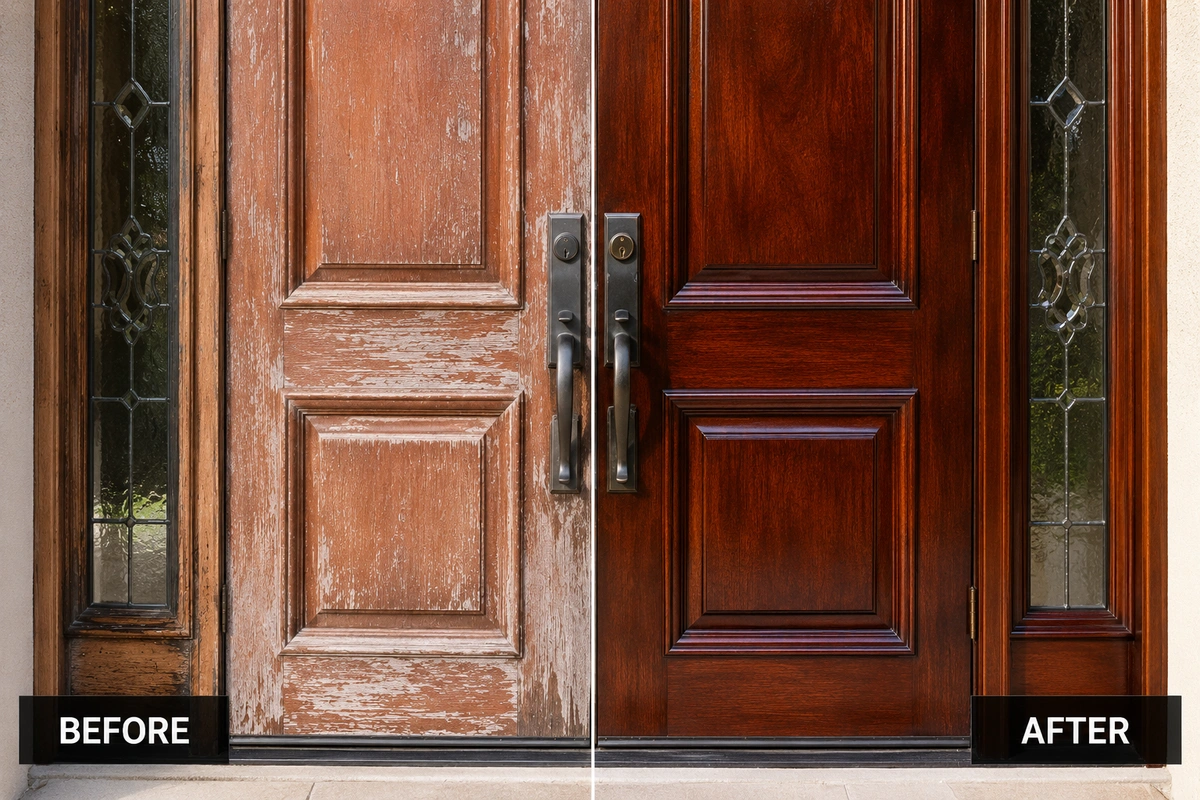
Light Refresh (Maintenance Level): For doors that have lost some luster but haven’t yet developed structural peeling or deep UV damage. This tier involves degreasing, light scuff-sanding, and a fresh protective topcoat. It’s the fastest and most affordable tier, and it’s the one proactive homeowners use to stay ahead of full finish failure — especially useful in coastal ZIPs where the humidity cycle moves faster than most homeowners expect.
Full Restoration (Most Common Tier): For sun-faded, peeling, clouded, or heavily weathered doors where the original finish has failed. This tier requires complete stripping or deep sanding down to bare material, repair of any surface damage, and a full climate-matched stain and multi-coat clear system. This is the tier where coastal vs. inland cost drivers diverge the most, since the prep and coating steps are fundamentally different between the two zones.
Premium / Custom Finish (Architectural Level): For fine hardwoods like genuine mahogany or teak, oversized or multi-panel entries, or projects that need to color-match a door to an adjacent iron gate or custom hardware. This tier reflects the extra handling, extended cure times, and specialized chemistry these materials require, regardless of whether the property is coastal or inland.
| Investment Tier | Typical Scope | Best For |
|---|---|---|
| Light Refresh | Degrease, scuff-sand, fresh protective topcoat | Minor fading, no cracking or peeling yet |
| Full Restoration | Complete strip or deep sand, repair, climate-matched stain and multi-coat seal | Peeling, clouding, or heavily sun-damaged doors |
| Premium / Custom Finish | Specialized chemistry for fine hardwoods, oversized doors, or multi-material color-matching | Mahogany, teak, custom iron-and-wood entries |
Door Refinishing Cost by San Diego Location
Because coastal and inland exposure drives so much of the cost equation, where your door actually sits matters more than any other single factor. Here’s how pricing tends to shift across the specific areas we serve — each linked to its full local breakdown.
In the immediate La Jolla door refinishing service area, salt fog and constant marine layer exposure push most projects toward the Full Restoration tier faster than in less exposed coastal zones, since the humidity swing here is some of the most aggressive in the county. Point Loma door restoration carries a similar profile, with the added factor of heavier iron and metal security door density, which adds rust-remediation line items that pure wood-door coastal properties don’t face.
Moving up the coast, Del Mar door restoration and Solana Beach door refinishing properties see the same marine-grade coating requirement, though bluff-top homes in particular face slightly higher wind-driven salt exposure that can shorten the interval between recoats. Encinitas coastal door refinishing and Carlsbad door restoration specialists work sits within the broader North County Coastal door refinishing guide service zone, where the four-lagoon humidity belt adds a distinct moisture-management factor to the coating system beyond typical coastal salt exposure alone.
Further south, properties across the Greater San Diego Suburbs door refinishing zone — Chula Vista, National City, El Cajon, La Mesa, and Santee — sit in a genuine transition belt rather than a clean coastal or inland category. Chula Vista and National City catch enough bay-adjacent humidity to need a marine-leaning coating system, while El Cajon and Santee flip fully into dry-heat pricing territory, with thicker UV-resistant builds needed to prevent cracking in some of the hottest sustained temperatures in the county.
Inland, the Inland Luxury Neighborhoods door refinishing zone — covering Rancho Santa Fe, Poway, and Scripps Ranch — tends to run toward the Premium tier more often than other inland areas, driven less by climate severity and more by the prevalence of large custom hardwood entries and HOA-governed finish standards in these communities. Estate-scale properties in Rancho Santa Fe in particular often include oversized double-door entries or matched iron gate sets, which shift a project into Premium territory on complexity alone, independent of the dry-heat coating requirements the ZIP code would otherwise call for on its own.
Within the Greater San Diego Suburbs zone, Chula Vista deserves its own callout: it’s close enough to the bay to need a marine-leaning coating system similar to true coastal ZIPs, but it doesn’t carry the same salt-fog intensity as La Jolla or Point Loma, which typically keeps projects there priced closer to the middle of the coastal range rather than the top. That’s a useful example of why the coastal-vs-inland split described earlier in this guide is really a spectrum, not a hard line — and why a location-specific estimate matters more than a county-wide average.
For the complete picture across every zone described above, the San Diego door refinishing hub breaks down microclimate exposure by region in more detail, and our Southern California service areas page covers coverage beyond San Diego County itself.
Material and Condition: The Two Non-Location Cost Factors
Location sets the baseline coating system, but two other factors move the price within that baseline regardless of ZIP code. Wood species matters significantly — solid hardwoods like mahogany or oak require more careful stripping and staining time than fiberglass, while iron gates and security doors are priced around the extent of rust remediation needed rather than square footage. Door configuration matters just as much: a single standard entry is priced differently than an oversized custom door, a double-door entry, or a multi-panel garage door.
Current condition is often the single biggest swing factor within any tier. A door that’s only lightly faded costs meaningfully less to restore than one with active peeling, cracking, or water damage, since damaged doors require substantially more prep work before any new finish can be applied — and that prep work is where labor hours, not materials, drive most of the cost difference.
Access and door count add a final layer. A single, easily reachable front entry is the simplest scenario to price. A multi-door project — front entry, garage door, and a side or rear gate refinished together — usually costs less per door than tackling each separately later, since prep equipment, travel, and setup are shared across the visit. Doors that require full removal from the hinges for shop-level work, rather than an on-site refinish, also add time on both ends of the project, though it’s often worth it for severely damaged or structurally complex doors where on-site work alone wouldn’t achieve a lasting result.
Does Timing Affect Cost Too?
Location and condition explain most of the pricing gap, but timing plays a smaller, often-overlooked role. Coastal properties tend to see the sharpest finish deterioration right after the late-spring-into-summer marine layer season, when months of daily humidity cycling have had the most time to work into an aging coating. Homeowners who schedule refinishing before that cycle sets in each year — rather than after visible peeling has already started — usually qualify for the Light Refresh tier instead of a full strip-and-restore, which keeps the project smaller in scope regardless of ZIP code.
Inland properties follow a different seasonal logic. The most aggressive UV damage accumulates through the long, dry summer stretch, so doors that go into fall already showing chalky discoloration or surface checking are more likely to need the full stripping process rather than a maintenance coat. In both zones, the underlying principle is the same: the earlier a failing finish is caught, the more likely the project stays in a lower-cost tier, which is one more reason a location-aware assessment matters more than a generic phone estimate.
How to Get an Accurate, Location-Specific Estimate
Because coastal and inland pricing diverges this much, a generic phone quote that doesn’t account for your specific ZIP code isn’t especially reliable. The most accurate way to get a real number is a photo-based or on-site assessment that identifies your door’s material, current condition, and exact climate exposure — a south-facing door in Santee is priced differently than a shaded entry in La Mesa, even within the same suburb.
A useful gut-check when comparing quotes: ask directly whether the coating system changes based on your address. A contractor who quotes the exact same product and process for a La Jolla coastal home and a Rancho Santa Fe inland estate hasn’t actually accounted for the variable that drives most of the cost difference in the first place — which usually means the lower number on paper won’t hold up to San Diego’s actual climate over the following few years.
| Get Your Free, Location-Specific Estimate |
|---|
Frequently Asked Questions
Why does door refinishing cost more near the coast than inland in San Diego?
Coastal properties need marine-grade, flexible coating systems and rust-inhibiting hardware treatment to withstand salt air and humidity swing, which requires more prep steps and materials than standard inland UV-resistant finishes.
Is inland door refinishing always cheaper than coastal?
Not always — inland ZIP codes like Rancho Santa Fe and Poway often carry premium pricing due to larger custom hardwood doors and HOA finish standards, independent of climate severity.
Which San Diego ZIP codes see the highest refinishing costs?
The immediate coastal core — La Jolla (92037), Point Loma (92106), and Coronado (92118) — tends to run highest due to combined salt exposure and humidity-driven prep requirements.
Does my door’s current condition affect price more than location?
Both matter, but condition often swings price more within a tier — a lightly faded door costs less to restore than one with active peeling or water damage, regardless of ZIP code.
Do iron gates and security doors cost more to refinish in coastal ZIP codes?
Yes. Salt air accelerates oxidation, so coastal iron and metal doors typically need rust-inhibiting primer work that inland metal doors don’t require.
How often will I need to refinish my door based on my location?
Coastal doors in the immediate marine layer zone often need shorter recoat intervals than inland doors, except in canyon heat pockets like El Cajon and Santee, which face their own accelerated wear pattern.
Can I get an accurate cost estimate without an in-person visit?
Yes — a photo-based assessment that captures your door’s material, condition, and orientation is usually sufficient for an accurate, location-specific estimate.
Does garage door refinishing follow the same coastal vs. inland cost pattern?
Yes. Garage doors are typically the largest unshaded surface on a property, so they experience the same climate-driven cost factors as front doors, often more intensely due to size.
Are transition-zone suburbs like Chula Vista priced like coastal or inland areas?
Neither exclusively — transition suburbs often need a hybrid approach, with some properties leaning coastal-humidity and others leaning inland-heat depending on proximity to the bay.
What’s the best way to compare quotes from different San Diego refinishers?
Compare on a like-for-like basis: same door, same tier (light refresh vs. full restoration), and confirm which prep steps and coating system are included for your specific ZIP code, not just a bottom-line number.
Get Your Free, Location-Specific Estimate
Whether your door sits three blocks from the Pacific or twenty miles inland, the fastest way to know what refinishing actually costs for your specific property is a free, photo-based estimate tailored to your exact location and door condition. Call (619) 777-7171 or submit the form above.