Table of Contents
When it comes to door refinishing, homeowners often face the dilemma of whether to take on the project themselves or hire a professional. In this article, we’ll explore the pros and cons of DIY and professional door refinishing to help you make an informed decision.
The Short Answer: Should You DIY or Hire a Professional?
DIY door refinishing is a reasonable weekend project in three cases: an interior door, a sound door that only needs a light scuff-and-recoat, or a fiberglass door that just needs fresh gel stain. A professional refinish is usually the better value for an exterior wood entry door in coastal San Diego, especially mahogany, knotty alder, or a double door. On the coast, the finish has to survive salt air, marine-layer moisture, and year-round UV, not just look good on day one.
Four things decide it: the door’s material, its exposure, the age of the existing finish, and how long you can leave your entryway open. For the budget side, our breakdown of what door refinishing actually costs in San Diego explains why coastal and inland quotes differ.
| Your Situation | Better Fit | Why |
|---|---|---|
| Interior door, light wear | DIY | Low exposure; mistakes are easy to redo |
| Fiberglass door, faded but intact | DIY or professional | Gel stain is workable; a failing factory finish needs professional prep |
| Exterior wood door facing sun or salt air | Professional | Needs a multi-coat, UV-protected system built for the coast |
| Peeling varnish, gray or black-stained wood | Professional | Requires a full strip, repair, and conditioning |
| Pre-1978 home with painted or very old finishes | Professional (lead-safe) | Stripping may disturb lead-based coatings |
| Double doors, pivot doors, wood garage doors | Professional | Size, weight, and a tight weather window |
What San Diego’s Coastal Climate Adds to This Decision
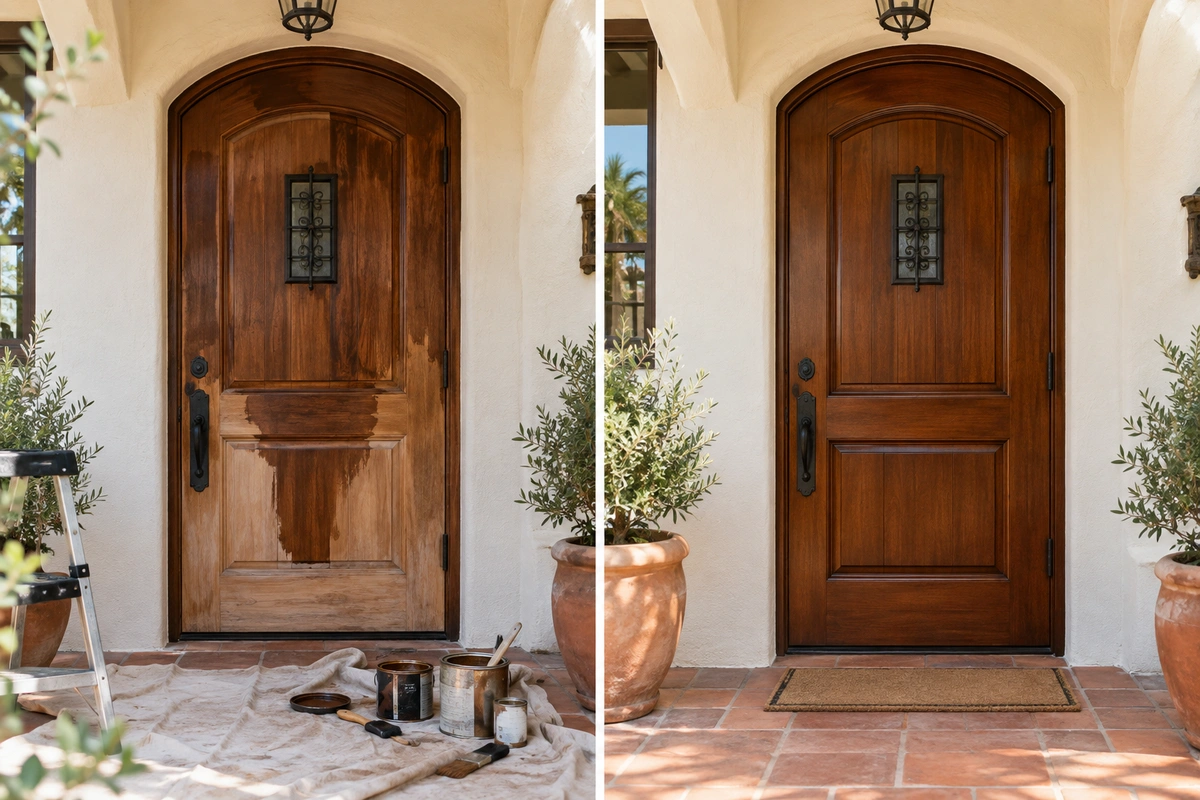
The pros and cons below apply anywhere — but San Diego and the surrounding Southern California coast put a wood door through a specific kind of stress that’s worth understanding before you decide which path to take. Salt air from the Pacific, marine-layer humidity, and strong UV exposure all work on a wood door simultaneously, and how well a finish holds up against that combination depends heavily on materials most DIY products aren’t formulated for.
| Condition | Typical Exposure in San Diego | Effect on Wood Doors | What This Means for DIY vs. Professional |
|---|---|---|---|
| Salt air | Year-round, most severe within a few miles of the coast | Accelerated finish breakdown, corroded hinges and hardware | Requires a salt-resistant topcoat most consumer-grade stains aren’t built for |
| Marine-layer humidity | Common mornings and evenings, especially in coastal neighborhoods | Wood swelling, finish delamination if not properly conditioned | DIY conditioning steps are often skipped or under-applied, shortening finish life |
| UV exposure | High year-round given San Diego’s consistent sun | Stain fading, varnish chalking and cracking | Professional-grade UV-protected varnish typically outlasts store-bought sealant |
| Hardware oxidation | Common on hinges and handles near the coast | Rust that stains and damages surrounding wood if untreated | DIY refinishing rarely addresses hardware treatment as part of the process |
This is part of why a DIY refinish and a professional one can look nearly identical on day one but age very differently within a year or two along the coast — the gap isn’t really about skill with a paintbrush, it’s about whether the underlying materials were ever built to handle San Diego’s specific combination of salt, sun, and marine humidity.
DIY Door Refinishing
Pros:
- Cost Savings: One of the primary advantages of DIY door refinishing is the potential for cost savings. By tackling the project yourself, you can save money on labor expenses.
- Personal Satisfaction: Completing a DIY door refinishing project can give you a sense of accomplishment and satisfaction in knowing that you’ve improved your home with your own hands.
- Flexibility: When you choose to refinish your door yourself, you have complete control over the project’s timeline and can work at your own pace.
Cons:
- Time-Consuming: Refinishing a door can be a time-consuming and labor-intensive process, especially for those with limited experience.
- Risk of Mistakes: Without professional experience, you may be more prone to making mistakes that could result in an unsatisfactory finish or even damage to your door.
- Limited Access to Professional-Grade Materials: DIY enthusiasts may not have access to the same high-quality materials and tools as professionals, potentially impacting the final result.
Professional Door Refinishing
Pros:
- Expertise: Hiring a professional ensures that the job will be done correctly and efficiently, as they have the necessary experience, knowledge, and tools.
- High-Quality Results: Professionals have access to top-quality materials and equipment, ensuring a beautiful and durable finish for your door.
- Time Savings: A professional can complete the refinishing project much faster than the average homeowner, freeing up your time for other tasks or leisure activities.
Cons:
- Cost: Hiring a professional door refinisher will typically be more expensive than doing it yourself, as you’ll need to cover labor and materials costs.
- Scheduling: Working with a professional may require you to accommodate their schedule, which could potentially cause delays or inconveniences.
The Hidden Risks of DIY Door Refinishing That Most Guides Miss
Most comparisons treat DIY door refinishing as money traded against time. In California, three less visible factors often decide the outcome: what’s in the old finish, what you’re allowed to strip it with, and what the weather does while the door is open.
Lead Paint in Older San Diego Homes
If your home was built before 1978 and the door has ever been painted, it may carry lead. The same applies to doors with decades-old finish layers. Sanding, scraping, or heat-gunning those coatings can release lead dust.
The EPA’s Renovation, Repair and Painting (RRP) Rule requires contractors who are paid to disturb painted surfaces in pre-1978 homes to be lead-safe certified. Homeowners working on their own homes aren’t bound by that rule, but the health risk is the same. It is highest for young children and pets near the doorway. At minimum, test the finish before stripping. If the test is positive, it’s no longer a DIY job.
Chemical Strippers, VOC Limits, and California-Compliant Products
Federal rules have removed methylene chloride paint strippers from consumer shelves. As a result, today’s DIY strippers work more slowly and often need several applications on thick varnish.
California also limits solvent content. In San Diego County, architectural coatings must meet the VOC limits in the Air Pollution Control District’s Rule 67.0.1. Many shelf products are therefore waterborne or low-VOC formulas. These raise the grain, flash-dry in direct sun, and leave lap marks unless you work quickly in shade.
Oil-soaked stain rags are also a genuine fire hazard. They can self-heat and ignite when balled up in a trash can, so they need to dry flat outdoors or go into a sealed metal container filled with water.
Weather Windows and an Open Entryway
A proper exterior refinish takes several days of coats and cure time, and San Diego weather works against each stage. Morning marine layer adds moisture to bare wood. Afternoon sun flash-dries stain. A Santa Ana day blows grit into wet varnish. Homeowners we serve for Point Loma door refinishing know how quickly the peninsula’s salt spray exposes a shortcut.
Security is the other overlooked problem: a DIYer either rehangs a heavy door every night or leaves the entry covered in plastic. If you still want to try it with the door hanging, our guide on how to refinish a wood front door without removing it covers the safer approach.
Why On-Site Professional Refinishing Closes the Gap Listed Above
Two of the cons listed above — cost and scheduling — are worth a closer look, because how a company actually delivers the service changes both.
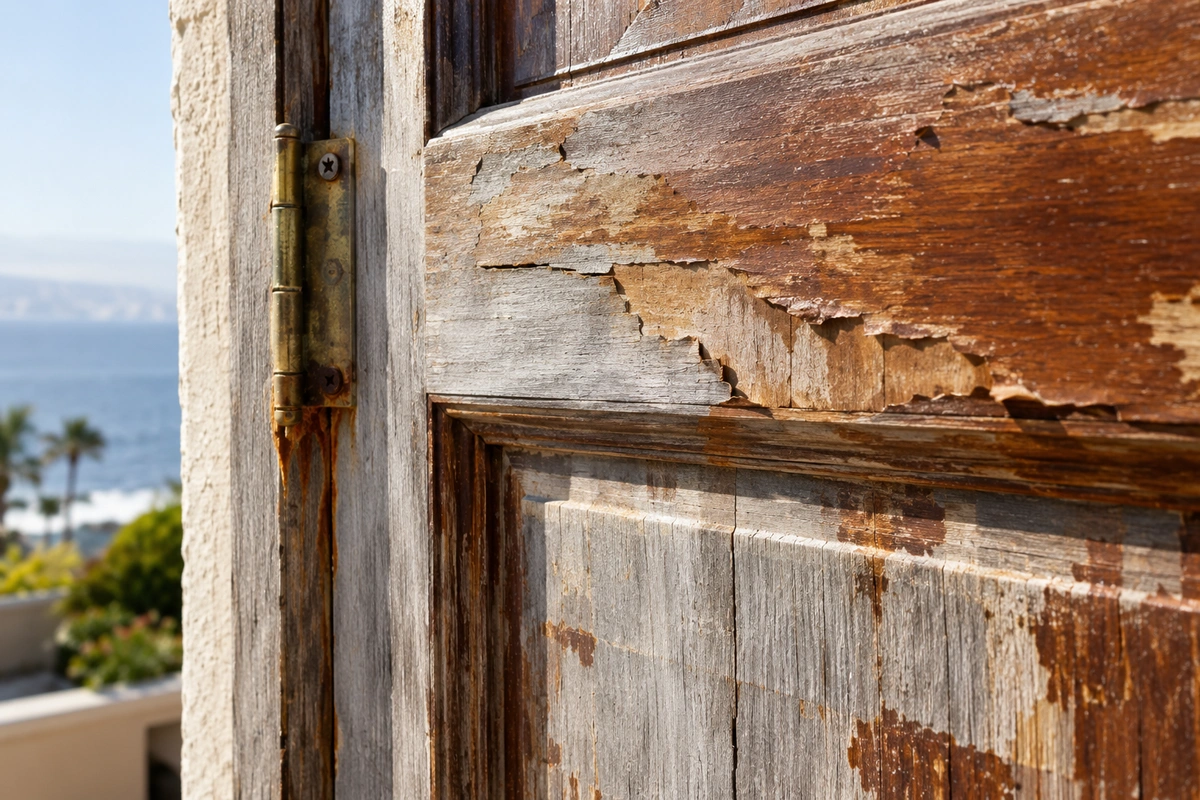
On cost: the “professional is more expensive” comparison above assumes a generic quote. In practice, refinishing is still dramatically cheaper than replacing a door outright, professional or not — the real cost comparison that matters is refinishing versus replacement, not DIY versus professional. Door Refinishing California refinishes on-site, without removing your door from its frame in nearly every case, which also avoids the transit and rehanging risk that makes a DIY removal-based project harder than it looks.
On scheduling: working around your timeline is easier when the crew isn’t trying to fit your project between shop visits. On-site service means the work happens at your home on a day that works for you, rather than your door sitting in a shop queue.
There’s also a factor the general pros-and-cons list above doesn’t cover at all: historic districts and HOA rules. In communities like Coronado’s Village Historic District, exterior changes — including door replacement — can require review from the city’s Historic Resource Commission, while many coastal HOA communities across San Diego County have their own color and finish requirements. Refinishing an existing door generally avoids that review process entirely, since you’re restoring the original rather than proposing something new. That’s not something a DIY guide or a generic professional-vs-DIY comparison usually accounts for, but it’s often the deciding factor for homeowners in designated or HOA-governed communities.
How Door Refinishing California Compares
When the decision is professional refinishing, the next question is who does it. Here’s how a dedicated door specialist compares with a general painter or handyman.
| Factor | General San Diego Painters / Handymen | Door Refinishing California |
|---|---|---|
| Core specialty | Wall and trim painting, general repairs | Wood door refinishing and restoration exclusively |
| Service location | Often requires door removal and drop-off | On-site, in nearly every case — the door never leaves your property |
| Coastal finish rating | Often standard exterior-grade product | Salt-air-appropriate, UV-protected topcoat built for the coast |
| Historic district experience | Varies, not always door-specific | Familiar with Coronado’s Historic Resource Commission and coastal HOA requirements |
| Stain process | Typically one or two coats, standard stain | Three to five coats, five-material proprietary technique |
For a broader look at our full service area, our Southern California service area page covers coverage in detail across San Diego door refinishing, North County Coastal door refinishing, Central & Coastal San Diego door refinishing, Inland Luxury Neighborhoods door refinishing, and Greater San Diego Suburbs door refinishing.
DIY vs. Professional Door Refinishing, Stage by Stage
Whether a finish lasts or fails within a season is mostly decided before any stain touches the wood. This table compares a typical DIY project with the process our crews follow on-site at each stage.
| Stage | Typical DIY Approach | Professional Approach |
|---|---|---|
| Assessment | Quick visual check | Condition review and a refinish-vs-replace recommendation |
| Entry protection | Plastic sheeting or rehanging nightly | Heavy-duty temporary weatherproof door cover |
| Stripping | Partial removal with consumer stripper | Complete strip to bare wood, including panel profiles |
| Sanding | One or two grits, mostly by hand | Multi-stage progressive sanding for even grain exposure |
| Repairs | Filler that shows through the stain | Cracks and imperfections repaired before finishing |
| Conditioning | Often skipped | Two coats of premium door conditioner |
| Stain | One or two coats | Three to five coats, five-material technique with added sanding |
| Topcoat | One or two coats of retail varnish | Three coats of UV-protected varnish, gloss or satin |
The order of the steps matters more than any single product. Skipping conditioner on knotty alder or pine causes blotching that no topcoat can hide. A single coat of varnish on a south- or west-facing door doesn’t carry enough UV protection to last on the coast.
You can see the full sequence on finished doors in our before-and-after door refinishing portfolio. The complete scope of our wood door refinishing services covers entry, interior, and garage doors.
Which Doors Are Realistic DIY Projects? A Material-by-Material Guide
A door’s material changes the answer more than your skill level does. A fiberglass door and a mahogany door can both be “refinished,” but they need different products, prep, and topcoats.
| Door Type | DIY Suitability | Common DIY Pitfall | When to Call a Professional |
|---|---|---|---|
| Interior hollow-core or veneer | Good | Sanding through thin veneer | Veneer is lifting, chipped, or sanded through |
| Fiberglass entry door | Moderate | Streaky gel stain, incompatible topcoat | Factory finish is chalking or peeling |
| Mahogany | Low | Natural oils resist stain, causing uneven color | Any exterior mahogany facing sun or salt air |
| Knotty alder or pine | Low to moderate | Blotching without conditioner | Exterior doors, or a blotchy earlier DIY attempt |
| Wood garage door | Low | Drips on vertical panels, short weather window | Nearly always |
| Wrought iron or steel | Low | Painting over rust without treating it | Rust bleeding, flaking, or pitting |
Fiberglass gives DIY the best odds, which is why “gel stain for fiberglass door” is such a common search. Gel stain only looks right when the factory coat is properly cleaned and scuffed first and then sealed with a compatible exterior clear coat. If you’re still choosing a material to live with long-term, our comparison of fiberglass vs. wood entry doors covers durability on the coast.
Solid mahogany and alder doors on older coastal homes are where professional prep pays off most; they make up much of our work in door refinishing in La Jolla. For carved doors, cabinet doors, or matching trim, see our custom wood refinishing services.
Signs Your Door Is Already Past the DIY Stage
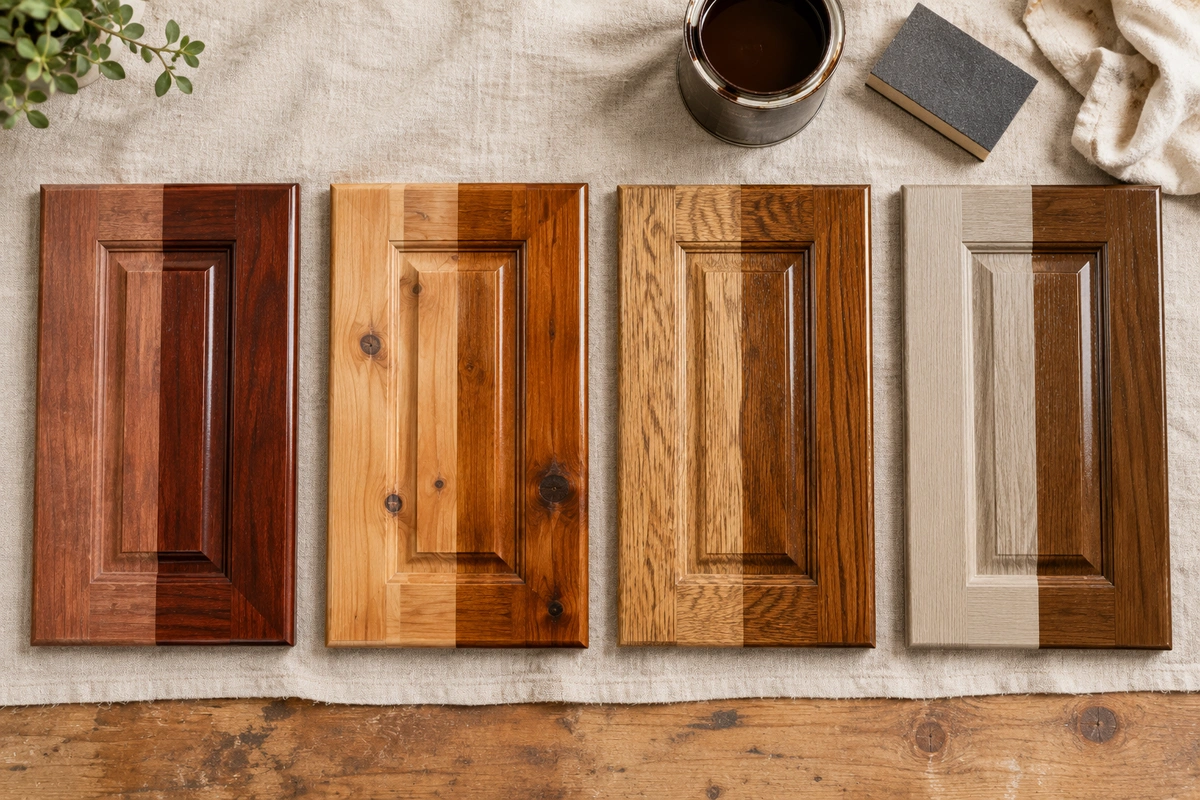
Some door conditions look cosmetic but are actually moisture or structural problems. Refinishing over them only hides the damage for a few months.
Get a professional assessment before buying supplies if you see any of these:
- gray or black wood where the finish has completely failed
- varnish peeling off in sheets rather than wearing thin
- soft spots near the bottom rail or threshold
- panels splitting away from their frame
- rust stains bleeding from hinges into the wood
- a door that sticks seasonally, which signals moisture movement
Several of these can be addressed through our door repair and maintenance service rather than a full refinish. Coastal North County homes show these symptoms fastest, and our page on Carlsbad wood door restoration explains why lagoon humidity accelerates them.
Real Reviews from California Customers
We’re rated 5.0 stars across 110+ Google reviews, and we’d rather let recent California customers describe the work than describe it ourselves.
“I waited a few weeks before writing this because I wanted to be sure. After rain, sun, and daily use, the door still looks fantastic. The finish isn’t sticky, blotchy, or overly shiny. It just looks like good wood taken care of properly. That’s exactly what I wanted. I recommend their services and I think they had fair pricing compared to the quality they provided.” — Ali Fazeli
“I recently hired California Door & Wood Refinishing for a complete refurbishing of my front door and some interior woodwork, and I couldn’t be more pleased with the results. From the initial consultation to the final coat of finish, their team was professional, punctual, and highly skilled.” — Shalaw Showan
“We had a 40 year old wood door in our California home, they did the best door refinishing and antique refinishing — now it keeps the history but looks completely new.” — Yah Ab
Frequently Asked Questions: DIY vs. Professional Door Refinishing
These are the questions San Diego homeowners ask most often while deciding whether to refinish a door themselves. Broader questions about materials, timelines, and service are answered in our full door refinishing FAQ.
Is it cheaper to refinish a front door yourself?
Upfront, yes, because you avoid labor. The savings narrow once you buy stripper, several sandpaper grits, conditioner, stain, exterior varnish, brushes, and a lead test kit. A finish that fails early also means paying twice. Either way, refinishing costs far less than replacing a quality wood entry door.
How long does DIY refinishing take compared with a professional?
A DIY exterior refinish usually stretches across several days or weekends because of stripping, sanding, and drying time between coats. A professional refinish typically takes one to two days, depending on the door’s condition and the finish chosen.
Is gel stain a good DIY option for a fiberglass door?
Yes, it’s the most forgiving DIY product for fiberglass because it sits on the surface instead of soaking in. Results depend on thorough cleaning and scuffing, thin even coats, and a compatible exterior clear coat. Without those, the color fades or peels under San Diego’s UV.
Do I need to worry about lead paint on an old door?
Yes, if your home was built before 1978 and the door has painted or very old finish layers. Test before sanding or stripping. Contractors paid for this work must follow EPA lead-safe RRP practices.
How often does a refinished door need maintenance in San Diego?
It depends on exposure: a sheltered door lasts much longer than a sun-facing coastal one. Most doors benefit from annual cleaning with a mild detergent and a maintenance coat. Our guide on how often to refinish a door in San Diego lists the warning signs by exposure. If you’re comparing providers, our guide to choosing the best door refinishing company in San Diego covers the questions to ask.
Conclusion
Both DIY and professional door refinishing have their pros and cons. If you’re confident in your skills and have the necessary tools, DIY door refinishing can save you money while providing personal satisfaction. However, if you’re inexperienced or want the best possible result, hiring a professional may be the better option. Ultimately, the choice will depend on your individual circumstances, budget, and preferences.
Get Your Free Door Refinishing Quote
Whichever way you lean after weighing the pros and cons above, we’re happy to assess your specific door on-site and give you a straight answer about what it actually needs.
Send photos of both sides of your door, the bottom rail, and any damaged areas, along with your ZIP code. We’ll tell you honestly whether it’s a good DIY candidate or needs professional work.
You can also call or text (619) 777-7171, Monday–Friday 7:30 AM–7 PM, Saturday 9 AM–6 PM, and Sunday 9 AM–5 PM. Our office is at 12154 Putting Green Row, San Diego, CA 92128, or you can contact our San Diego team online.